
This summer, as part of SITES AquaNet, lake mesocosm experiments at SITES stations Erken and Svartberget were set up to test the effect of soil particles on lake water. A third SITES station, Lönnstorp, was included in the experiment, as the soil particles added to the mesocosm were collected as a composite from several fields at the agricultural field station.
As a result of ongoing climate change, inland waters will experience more variable inputs of soil-derived dissolved and particulate matter from the surrounding catchment into lakes. Such runoff can transport different types and amounts of mineral particles into a recipient lake ecosystem. How such dynamic interactions are modified depending on different rates of mineral inputs and ambient conditions of the lakes is poorly understood, particularly under natural conditions at the lake/catchment scale.
To address this, in June 2026, researchers from across Europe, and as far as Brazil, joined a collective mesocosm effort to understand the dynamic role of particle inputs to lake water. The mesocosm experiments were set up at two contrasting SITES lakes, Lake Erken (a deep, clear water lake) and Stortjärn (a small, humic lake), and were coordinated so that the agricultural soil particles were added at the same time at three different concentrations with one control. The treatments were run with four replicates, and the experiment ran for two weeks. Researchers bonded over the great experiences and are looking forward to examining the effects across treatments and lake sites.
Interested in using the SITES AquaNet set up for a future expermiment? Apply via the open call applicaiton.
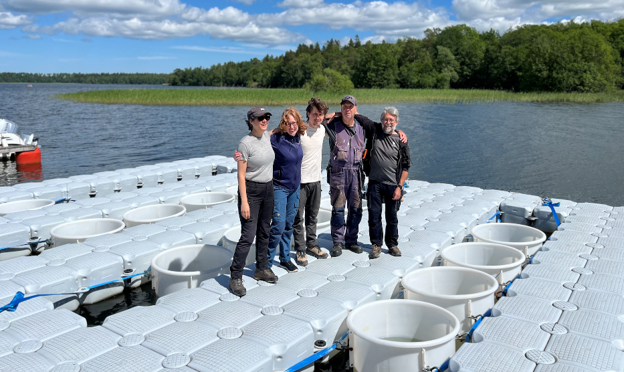
Photo: Erken experimental mesocosm study site during the installation of mesocosms, June 2026. From left to right: Dolly Kothawala, Silke Langenheder, Simone Wentritt, Christer Standberg, William Colom.