
Dr. Tobias Rüttning is one of the authors of the paper "Pb and Fe flow through the mire-lake complex of Skogaryd catchment – a system under anthropogenic influence", recently published in EGUsphere. This study was conducted at Myckelmossen, a peatland (mire) located within Skoargaryd Research Catchment. In this interview, the author shares his insights with the SITES Community about the project and added value of SITES open data.
 What is the motivation behind studying the flow of metals in peatlands?
Peatlands can store large amounts of various metals, such as lead (Pb) and iron (Fe), which are either derived from bedrock or anthropogenic sources. Some of these metals are involved in stabilizing the organic matter in the peatland, while others are toxic to living organisms. The mobilization and export of metals from peatlands, and their fate in the downstream catchments, have received little attention, but is important to investigate to assess water quality and pollution.
What are the main findings of your project?
Our study showed that the investigated peatland, Mycklemossen, has high lead (Pb) concentration, of anthropogenic origin, probably from the earlier use of lead in gasoline. The Pb in the peatland and downstream water at times reached toxic levels, exceeding regulatory threshold values. Our study also showed that within the catchment, lakes can act as a sink for Pb and other metals mobilized from peatlands, thereby limiting the impact on the ecosystem and water quality further downstream.
Has a collaboration with other researchers, research groups, stakeholders and companies taken place?
The project was a collaboration between researchers from University of Gothenburg and University of Copenhagen and further included international researchers from Brandenburg University of Technology (Germany) and the University of Cambridge (UK), bringing together experts from different subject areas.
What has been done at SITES Skogaryd?
Myckelmossen is a pristine peatland (mire) located within Skoargaryd Research Catchment. At Mycklemossen we collected peat cores to a depth of 4.5 m, which we dated and analyzed for various metals and other elements. We combined this with stream chemistry and stream discharge data collected within the SITES Water monitoring program. We further analyzed the lead (Pb) isotopes in the peatland as well as the stream samples to identify if the high Pb concentrations are natural or from anthropogenic pollution, where the latter was true.
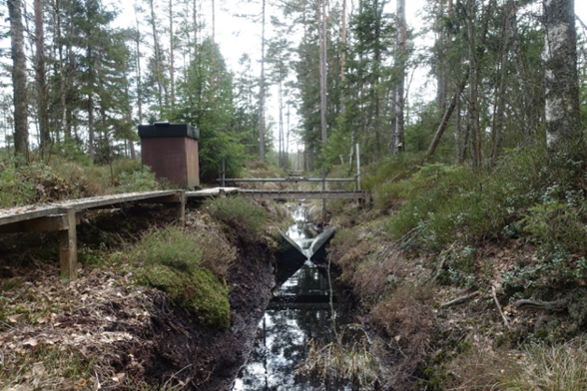
Photo: V-notch at Mycklemossen, where the water samples are taken for SITES Water (Leif Klemedtsson)
What support have you gotten from SITES station staff?
The station staff at Skogaryd assisted with the peat sampling. But their most valuable contribution is the regular sampling within the SITES Water monitoring program, without which this study could not have been carried out.
What is the added value in performing data collection at SITES stations?
The whole study arose just out of opportunity, bringing together independently collected data. So, in a way it was not planned research. When our colleagues from Copenhagen made some elemental analysis in peat cores from Mycklemossen, we did not specifically target lead (Pb). When we saw an interesting Pb profile, that alone would not have made for an interesting story. Only because of the openly available background Pb measurements of SITES Water in the streams, where the stream outflowing from Mycklemossen had very high concentrations, made this an interesting story. Without SITES, we would not have had those data.
Have you used data from the stations long-term data series?
We used stream chemistry and stream discharge data from the SITES Water program, as well as the meteorological data collected.
Stream data from Mycklemossen can be accessed here. You are welcome to explore and use this data as well as additional SITES Water data from Skogaryd Research Catchment but please be sure to acknowledge SITES and the data use.