
Like for some other taxa and most parts of the world there is a lack of knowledge about insect diversity, and available data are instead patchy and/or cover only tiny subsets of species. This is largely due to the generally low cost-effectiveness of insect surveys. In recent years the Insect Biome Atlas project (IBA), however, worked out a state-of-the-art method using Malaise traps and species identification via DNA metabarcoding. Based on this, Station Linné and the Swedish Museum of Natural History established a baseline describing the Swedish insect fauna in 2019-2024 where full year samplings at almost 100 sites across the country was used. For ca. 35 of those sites the Swedish Insect Monitoring Scheme (SIMS) is continued by the help of volunteers and interested organizations throughout Sweden. This internationally and unique 8-year data series will be used to provide the first long-term trend analyses for >99% of the known Swedish insect fauna for which little or no reliable information currently exists.
Starting this year, all SITES-stations added on to collect and deliver samples from Malaise traps within their respective areas distributed from southernmost Sweden up to Abisko above the Arctic Circle. For most of the year the sampling is weekly (in winter monthly or in the case of lots of snow closed) and collected specimens are sent to Station Linné for storage and future analyses. SITES is happy to contribute to the only nationwide insect monitoring and be part of the description of the present diversity.
SITES provides a platform for consistent sampling and biodiversity data collection across spatial gradients, such as the case with the SIMS project. To see other Biological examples, you are welcome to explore SITES Biological Theme and data!
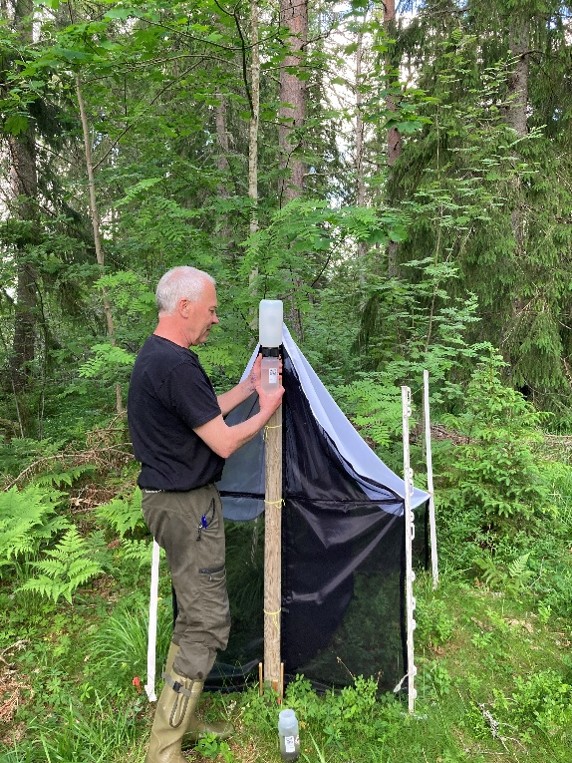
The sampling bottles are replaced weekly, here at the Malaise trap at Grimsö (Photo: Julia Björk).