
 How is your research connected to Bolmen?
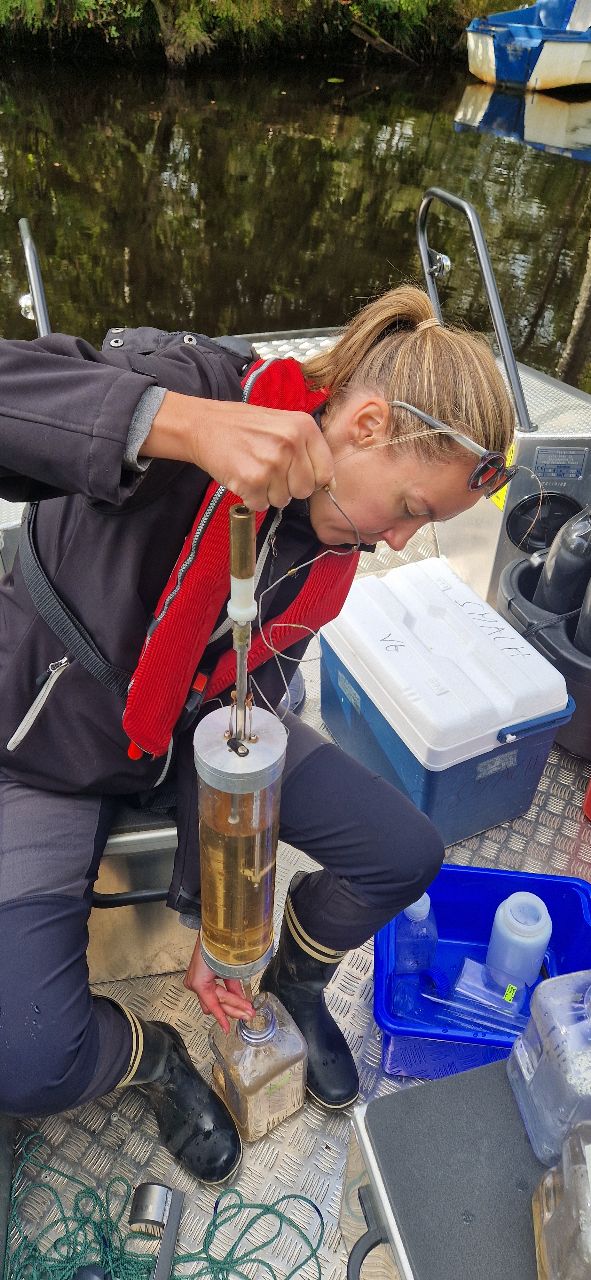
Over the past two years, I have deployed sediment traps in Lake Bolmen to collect settling material rich in iron and organic carbon. This work is part of an ongoing research project investigating how iron drives particle aggregation and transports organic carbon from the water column to lake sediments.
What is the motivation of your research project?
During recent decades, many northern lakes have experienced pronounced browning caused by increasing concentrations of dissolved organic carbon and iron. As these changes have ecological and water quality implications, understanding the role of iron in lake browning and carbon cycling has become increasingly important. Iron affects several key processes that determine the fate of organic carbon in lakes, including photochemical transformations and formation of iron-organic carbon aggregates that sink to the lake bottom, effectively transferring carbon into what has been termed a “rusty carbon sink”.
What type of measurements are made for your research project?
To investigate these processes, sediment traps were deployed along a gradient of increasing distance from the main inlets, corresponding to increasing water residence time. In addition to measuring water column concentrations and sedimentation rates of both iron and organic carbon, the project includes a detailed characterization of the chemical forms of iron and organic carbon across different lake compartments: the water column, settling aggregates, and sediments. These analyses are conducted using infrared spectroscopy and synchrotron-based techniques available at the MAX IV Laboratory in Lund.
Caroline Björnerås is Postdoctoral fellow at the Department of Geology, Lund University.