
A comprehensive dataset containing information on Zooplankton collected throughout the lake water column at Erken has been compiled and is now available on the SITES Data Portal (Open access to Zooplankton from Erken dataset).
The dataset starts in January 2012 and currently goes until 2022, with more data to come. The zooplankton community is described taxonomically by phylum, class, order, and scientific name. Information on life stage, abundance, biovolume, and biomass is available.
What are Zooplankton? Zooplankton are a key trophic link in lake food webs as they consume phytoplankton (algae) and bacteria, and in turn are consumed by fish or bigger zooplankton. Because of their central position in lake food webs, zooplankton can affect the intensity of algal blooms and fish production, as well as nutrient cycling. Zooplankton are important to monitor over time because their composition and abundance can be sensitive to changes in environmental conditions, including those driven by climate change. As water temperatures rise, there are indications that the life cycles of zooplankton shift, often causing peak populations to shift in timing, which can have consequences for the availability of food for fish and the density of phytoplankton blooms.
We encourage you to explore and use the Zooplankton dataset but please remember to acknowledge the use of SITES infrastructure and cite the dataset: “Erken Laboratory (2026). Zooplankton from Erken, 2012-01-18–2022-12-06 [Data set]. Swedish Infrastructure for Ecosystem Science (SITES). https://hdl.handle.net/11676.1/Y3x7uX_Hr4b7I7ngx7HmDWct”
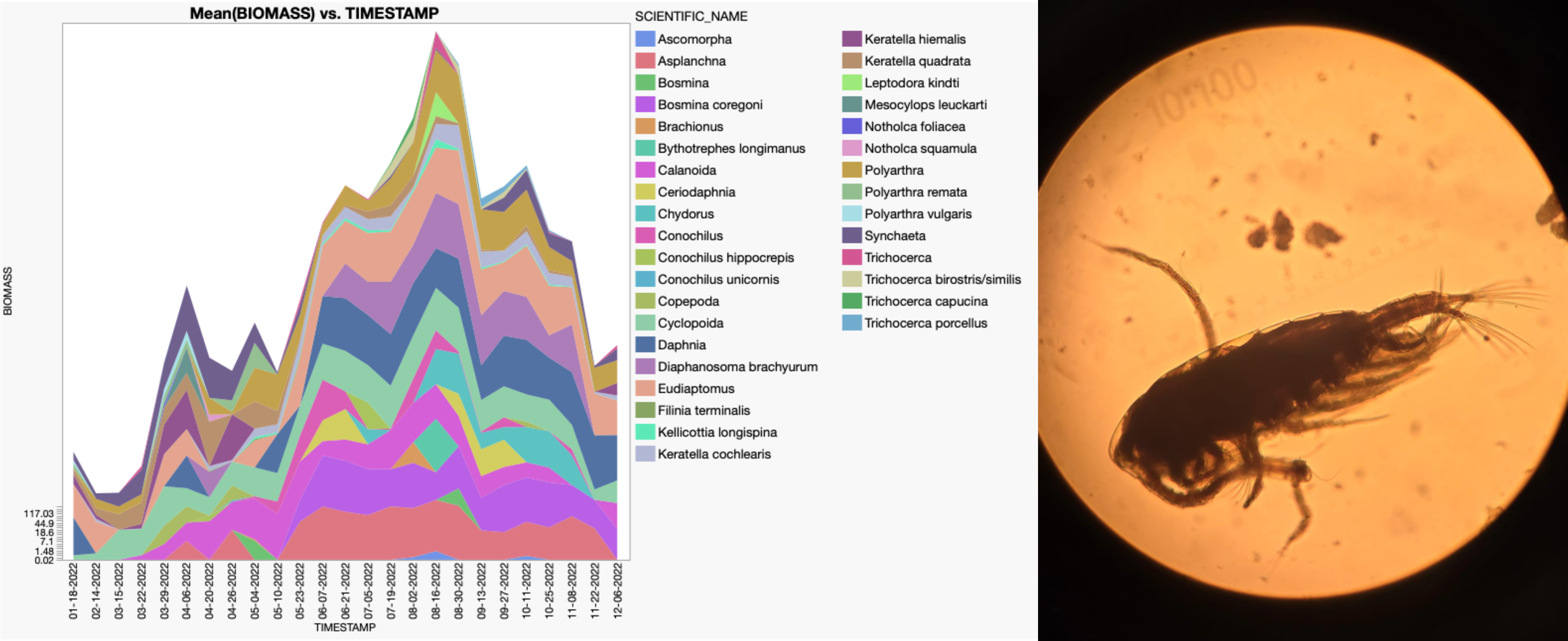
An example of the distribution of Zooplankton data by biomass for 2022, with visible peaks in the spring and summer (left). An example of a Calanoida copepod (right, photo credit: Robyn Övergaard).